An Aberdeenshire Barony
The Baron of Drum
In Sunshine and in Shade
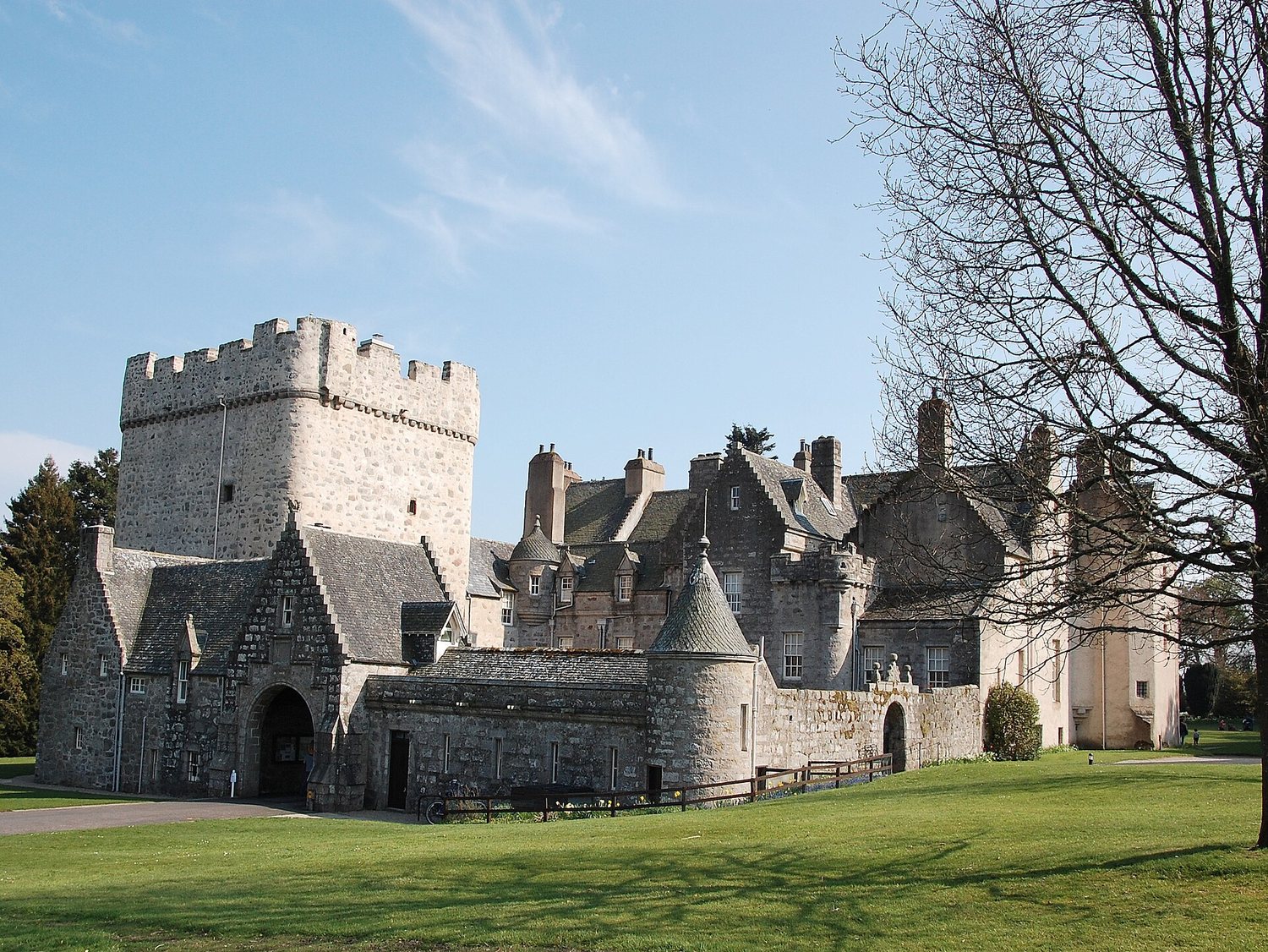
For seven hundred years the barony of Drum has belonged to one name. It began with a gift of royal forest from Robert the Bruce to the man who had carried his arms, and it has passed through twenty-seven barons, every one of them an Irvine. Their tower above the Dee is among the oldest still standing in Scotland, and their holly badge has come through battle, siege and exile.
A Forest from the King
The Irvines came north from the Borders. By the account kept in the family’s genealogies, William de Irwyn was a younger son of the Irvines of Bonshaw in Dumfriesshire, and served Robert the Bruce for some twenty years as his armour-bearer and secretary. In 1323 the king rewarded him with the royal forest of Drum, a broad tract of woodland and hunting ground on the north bank of the Dee, a few miles west of Aberdeen.
The family’s emblem dates from the same hard years. Tradition holds that after the defeat at Methven in 1306, William was one of a handful of men who hid with the fugitive king in a thicket of holly, and that Bruce afterwards allowed him to take the holly for his badge. The story cannot be proved, but the holly has stood on the Irvine shield ever since: three small bundles of it, green on silver, each bound with a band of red.
The Tower of Drum
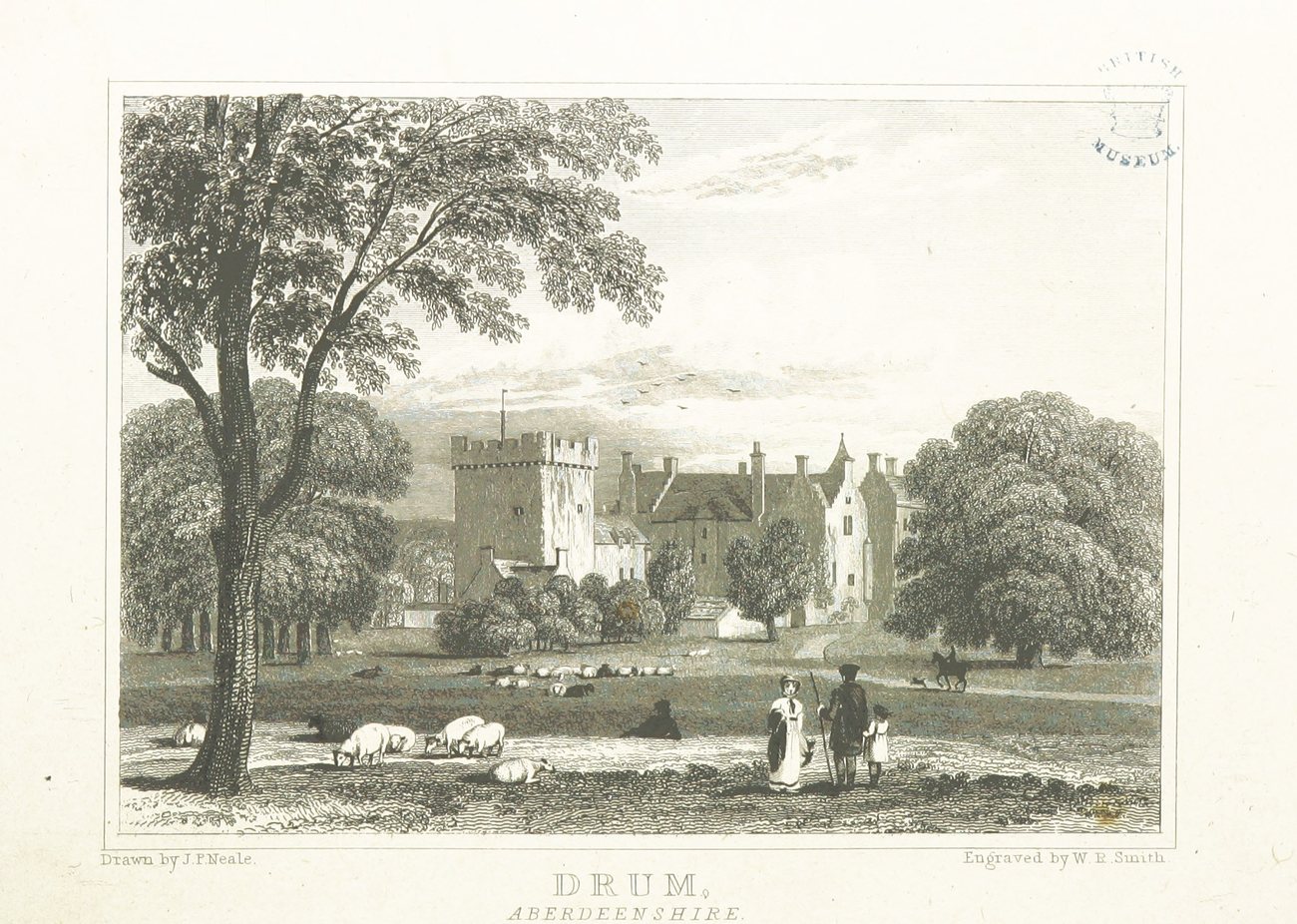
The forest came with a tower already standing in it. Historic Environment Scotland dates the great tower of Drum to the years around 1280 to 1300, which is believed to make it one of the three oldest tower houses in Scotland. It rises about seventy feet to a corbelled parapet, its rubble walls built around a vaulted basement, and it may be the work of Richard Cementarius, a royal master mason of the period.
In 1619 Alexander Irvine, the ninth laird, built a long house against the old tower, with crow-stepped gables and turrets in the manner of the north-east, and the two have stood side by side ever since. In 1875 his descendant Alexander Forbes Irvine called in the architect David Bryce to enclose a courtyard behind them.
Red Harlaw
The third laird, Sir Alexander Irvine, died in one of the bloodiest battles ever fought in the north-east. In the summer of 1411 Donald, Lord of the Isles marched an army of Highlanders and Islesmen towards Aberdeen in pursuit of his claim to the earldom of Ross. The lairds of the north-east met him at Harlaw, near Inverurie, on 24 July. Neither side could claim a victory, but the slaughter was so great that the battle passed into song as Red Harlaw.
The laird of Drum was among the dead. The histories of the Macleans tell how he met Hector Maclean of Duart, Red Hector of the Battles, in single combat, and that neither man left the field alive. The ballad of Harlaw gives him a line of his own, “Gude Sir Alexander Irvine, the much renownit Laird of Drum”, and his brother succeeded to the lands.
For the King
In the civil wars of the seventeenth century the Irvines declared for Charles I, and in Covenanting Aberdeenshire that made Drum a target. The house of Sir Alexander Irvine, the tenth laird, was attacked and plundered by Covenanter forces more than once in the 1640s, and his sons paid for the family’s loyalty in person. Robert Irvine died a prisoner in the dungeons of Edinburgh Castle. His brother Alexander, also a prisoner, was freed only after Montrose’s victory at Kilsyth in 1645.
Sheriffmuir and Culloden
The Irvines kept faith with the Stuarts after 1688. Alexander Irvine, later the fourteenth laird, was wounded fighting for the Jacobites at Sheriffmuir in 1715. He died without a son, and the barony passed to his uncle and then, under the family entail, to a cousin of the Artamford line.
A generation later the seventeenth laird, another Alexander, rode out for Prince Charles Edward Stuart and was at Culloden in 1746. After the defeat he came home in secret and lay hidden in a concealed room within the walls of Drum, and then escaped to France.
Drum and the Nation
The nineteenth century brought quieter lairds and longer tenures. Alexander Forbes Irvine, the twentieth laird, succeeded in 1861 and restored the house, adding the courtyard in 1875. The First World War reached Drum as it reached every family of its kind: the twenty-second laird, Alexander Forbes Irvine of the Grenadier Guards, was wounded in 1916 and died in 1922.
Henry Quentin Forbes Irvine, the twenty-fourth laird, made the decision that has kept Drum whole. Under an agreement first made with the National Trust for Scotland in 1964, the castle passed to the Trust in the mid-1970s, and it has been open to visitors ever since. The barony did not go with the stones. It passed to Charles Francis Irvine, and then to David Charles Irvine of Drum, the twenty-sixth baron and chief of the name, who in 2002 made a formal peace with the chief of the Keiths and ended a feud of some six hundred years.
The Barons of Drum, Succession
The barony has passed through twenty-seven holders, every one of them an Irvine. Dates before 1500 are approximate.
- 1st William de IrwynReceived the royal forest of Drum from Robert the Bruce, 1323.
- 2nd Sir Thomas de IrwyneSon of the first laird; laird from about 1335 (some lists name him William).
- 3rd Sir Alexander IrvineKilled at the Battle of Harlaw, 1411.
- 4th Sir Alexander IrvineBrother of the 3rd laird; succeeded 1411.
- 5th Alexander IrvineSucceeded about 1457.
- 6th Sir Alexander IrvineSucceeded 1493.
- 7th Alexander IrvineSucceeded 1527.
- 8th Alexander IrvineSucceeded 1554.
- 9th Alexander IrvineBuilt the house beside the tower, 1619.
- 10th Sir Alexander IrvineRoyalist; Drum plundered by Covenanters in the 1640s.
- 11th Alexander IrvineSucceeded 1658.
- 12th Alexander IrvineSucceeded 1687.
- 13th Alexander Irvine of MurthillA kinsman; succeeded 1696.
- 14th Alexander IrvineWounded at Sheriffmuir, 1715; died without a son.
- 15th John IrvineUncle of the 14th laird; succeeded 1735.
- 16th Alexander Irvine of ArtamfordSucceeded under the family entail, 1737.
- 17th Alexander IrvineAt Culloden, 1746; hid at Drum, then escaped to France.
- 18th Alexander IrvineSucceeded 1761.
- 19th Alexander Forbes IrvineSucceeded 1849.
- 20th Alexander Forbes IrvineSucceeded 1861; restored the house and added the courtyard, 1875.
- 21st Francis Hugh Forbes IrvineSucceeded 1892.
- 22nd Alexander Forbes IrvineGrenadier Guards; wounded 1916, died 1922.
- 23rd Alexander Forbes IrvineSucceeded 1922.
- 24th Henry Quentin Forbes IrvineSaw Drum Castle pass to the National Trust for Scotland.
- 25th Charles Francis Irvine, MCSucceeded 1975.
- 26th David Charles Irvine of DrumMade peace with the Keiths, 2002; died 2019.
- 27th Alexander Irvine of DrumThe present baron, 2019.
Green in Sun and Shade
David Irvine of Drum died in February 2019, and the barony passed to his son, Alexander Irvine of Drum, the twenty-seventh baron and Chief of Clan Irvine of Drum. The tower that the first laird received from the Bruce now belongs to the nation, but the title, the arms and the chiefship remain with the family, as they have since 1323. The family motto, Sub sole sub umbra virens, means flourishing in sunshine and in shade. Seven centuries of royal favour, civil war and exile have tested it, and the holly of Drum is still green.