Rulers of the Hebrides
The Lord of the Isles
Clan Donald and the Gaelic Sea-Kingdom
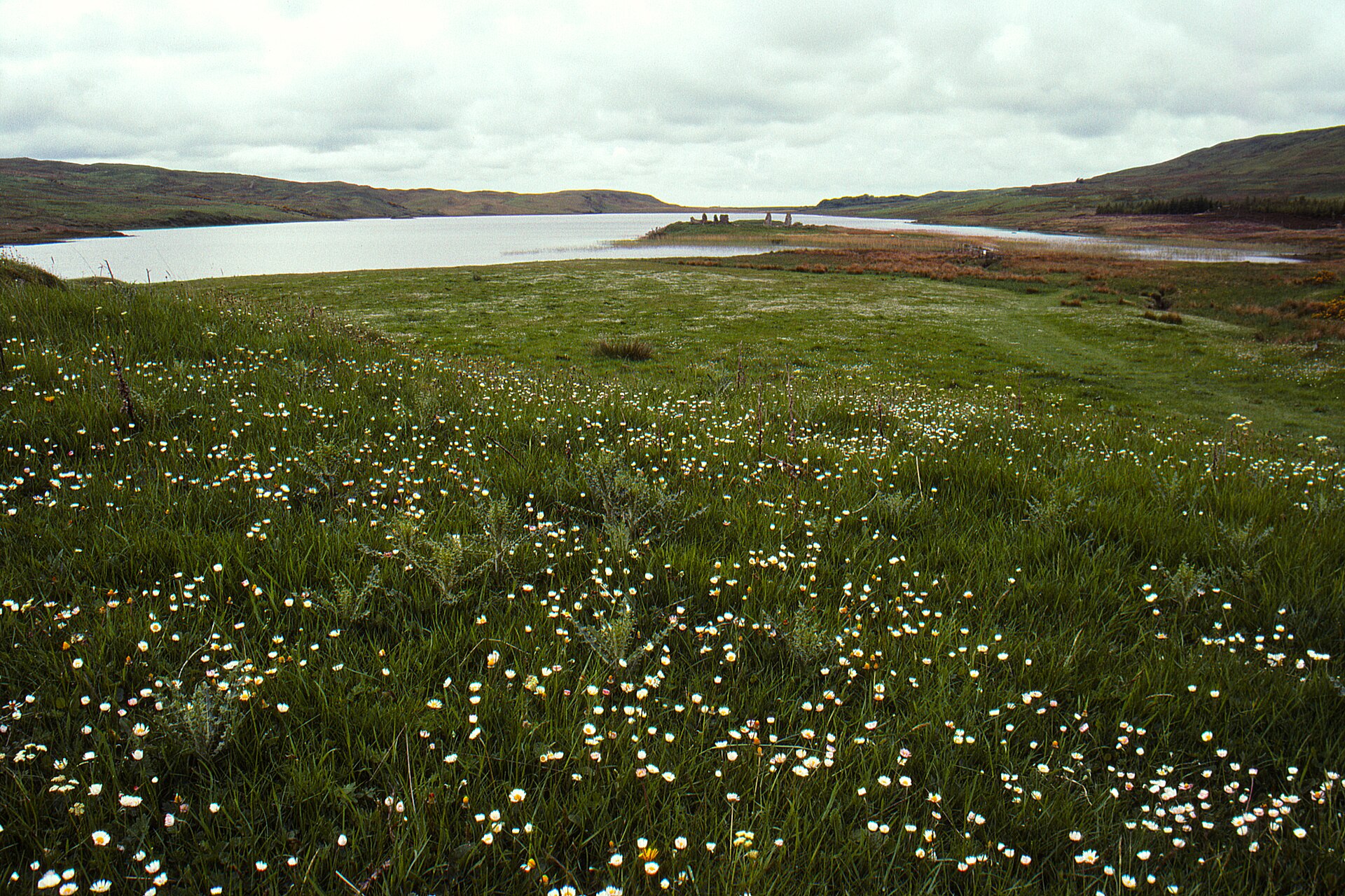
At its height the Lordship of the Isles was less a Scottish title than a rival kingdom: a Norse-Gaelic polity stretching across the Hebrides and the western seaboard, with its own laws, its own fleet of birlinns, and its own diplomacy with foreign crowns. Its chiefs, Clann Dòmhnaill, the sons of Donald, traced their power to Somerled, the warrior-king who wrested the Isles from Norse control in the twelfth century. For three hundred years they ruled from Finlaggan on Islay, the most powerful lords in all of Scotland. When James IV forfeited the lordship in 1493, he extinguished the last great Gaelic polity of the medieval north.
Somerled and the wresting of the Isles
The dynasty begins with Somerled — Somhairle in Gaelic — a man of mixed Norse and Gaelic blood who rose in the first half of the twelfth century to challenge Norse dominion over the western seaboard of Scotland. By a combination of military genius and shrewd alliance-building he expelled the Norse kings of Man from the Inner Hebrides and made himself, in effect, King of the Isles. His victory at a sea battle off the coast of Islay in 1156 established the shape of his realm. When he fell at the Battle of Renfrew in 1164, campaigning against the Scottish crown, he left behind a divided inheritance and three sons whose descendants would each found their own dynasties.
It was from Donald (Dòmhnall), grandson of Somerled, that the greatest of these lines took its name: Clann Dòmhnaill, Clan Donald. Through the thirteenth and early fourteenth centuries the family consolidated their grip on Islay, Kintyre, and the islands of the Inner Hebrides, steering a careful course between the declining Norse power and the rising ambition of the Scottish kings.
Angus Óg and the Bruce alliance
The critical moment in the rise of Clan Donald came in the Wars of Independence. Angus Óg MacDonald, Lord of Islay, threw his fleet and his galloglasses behind Robert Bruce at the darkest hour of the Scottish cause. His birlinns ferried Bruce and his fugitive household to safety among the islands; his warriors fought at Bannockburn in 1314. The reward was immense: lands, status, and a place as the foremost Gaelic lord in Scotland. The Bruce alliance gave the family the resources and the royal favour on which the full lordship would be built.
Finlaggan and the Council of the Isles
It was John of Islay, son of Angus Óg, who first styled himself Lord of the Isles — Dominus Insularum in the Latin of his charters — and established the institutions of a quasi-sovereign Gaelic state. His seat was Finlaggan on Islay, a fortified island in a loch where he built a great hall and chapel, and where the Council of the Isles convened on a smaller islet nearby. The council, composed of the bishops, abbots, and chiefs of the western clans, governed the lordship under a body of customary law distinct from the rest of Scotland. It was not merely a court of a great magnate; it was, in function if not in formal title, the parliament of a kingdom.
John’s lordship stretched from Kintyre to Lewis, from Islay to Lochaber, encompassing perhaps a third of the landmass of Scotland by extent. He contracted alliances with the English crown, the Kings of Ireland, and the MacDougalls of Lorn. His successors would press still further.
Harlaw and the height of the lordship
Donald, 2nd Lord of the Isles, brought the lordship to the brink of dominating all of northern Scotland. Through his mother he claimed the Earldom of Ross and the fertile lands of the eastern Highlands beyond the Great Glen. In 1411 he led a great army eastward to enforce that claim, reaching as far as Harlaw, near Aberdeen, where he fought a bloody and inconclusive battle against the forces of the Regent Albany. The Battle of Harlaw shook Lowland Scotland and fixed in its memory the image of the Lords of the Isles as a power that could threaten the kingdom itself.
His son Alexander eventually won the Earldom of Ross by negotiation, and under the 3rd Lord the lordship reached its territorial maximum. The family were patrons of the learned orders — the hereditary bards, harpers, and historians of Gaelic culture found their most generous supporters at Finlaggan. The Book of the Dean of Lismore, the great anthology of medieval Gaelic poetry, preserves the cultural world the Lords of the Isles sustained.
The Treaty of Westminster-Ardtornish and the forfeiture
The lordship began to overreach itself in the second half of the fifteenth century. In 1462 John, 4th Lord of the Isles, concluded the Treaty of Westminster-Ardtornish with the English crown, agreeing, in effect, to hold his territories as a vassal of England and to assist Edward IV in the conquest of Scotland. When the treaty came to light, James III was prepared to let the matter rest in exchange for formal submission. But John’s own illegitimate son Angus Óg rose in rebellion, and the resulting conflicts tore the lordship apart from within.
James IV, the most vigorous of the Stewart kings, used these disorders as his justification. In 1493 he declared the lordship forfeited to the Scottish crown. John, the last Lord of the Isles, surrendered his title and spent his remaining years as a pensioner at the royal court, dying around 1503. His forfeiture ended the last great independent Gaelic polity in Scotland.
The title after forfeiture
The forfeiture did not end the name. From 1493 the title Lord of the Isles passed to the Scottish crown and became a subsidiary dignity of the heir apparent. It has been held by the heir to the throne ever since, and today it is one of the Scottish titles of Prince William, Duke of Rothesay, the present Lord of the Isles. As one of the great historic dignities of the realm, the Lordship is numbered among the titles of the Baronage of Scotland, and its place among the living dignities of these islands is recorded in the Baronage Roll. The chiefship of Clan Donald continues separately, recognised by the Lord Lyon King of Arms, and Clan Donald remains one of the largest clans in Scotland and its diaspora. Armadale Castle on Skye serves today as the Clan Donald Centre, housing archives and exhibitions on the history of the family and the lordship.
At Finlaggan, the islets in their loch on Islay are silent now, the great hall reduced to low walls and the council chamber to a scatter of dressed stone. Yet the birlinns that once crossed the Hebridean swell from island to island, the laws that the council debated, and the poetry that the bards composed at the great lord’s table all belong to a civilisation that was, for a time, as sophisticated and as confident as any in northern Europe.
The Lords of the Isles, Succession
The lordship descended from Somerled through the Kings of the Isles and the chiefs of Clann Dòmhnaill, reaching its formal title under John of Islay in the fourteenth century before forfeiture to the Scottish crown in 1493.
Kings and Chiefs of the Isles
- — Somerled (Somhairle)King of the Isles and Argyll; expelled Norse rulers from the Inner Hebrides; fell at the Battle of Renfrew, 1164.
- — Donald (Dòmhnall)Grandson of Somerled; gave his name to Clann Dòmhnaill (Clan Donald); established the family’s dominance in Islay.
- — Angus Óg MacDonaldLord of Islay; supported Robert Bruce through the Wars of Independence; fought at Bannockburn, 1314; father of the 1st Lord of the Isles.
Lords of the Isles
- — John of Islay, 1st LordFirst to use the style Dominus Insularum; ruled from Finlaggan, Islay; established the Council of the Isles; d. 1386.
- — Donald, 2nd LordClaimed the Earldom of Ross through his mother; fought the Battle of Harlaw near Aberdeen, 1411; d. c. 1420.
- — Alexander, 3rd LordSecured the Earldom of Ross; the lordship reached its territorial maximum under his rule; greatest patron of Gaelic learning.
- — John, 4th and last LordConcluded the Treaty of Westminster-Ardtornish with England, 1462; lordship forfeited to the Scottish crown by James IV, 1493; d. c. 1503.
The sea-kingdom remembered
The Lords of the Isles left no dynasty but left everything else: the birlinns, the laws, the poetry, and the memory of a Gaelic civilisation that stood apart from lowland Scotland and refused, for three hundred years, to be absorbed by it. Somerled’s descendants built something rarer than a title -- they built a world. Its ruins at Finlaggan, low in the water of an Islay loch, still speak of what it was to rule by sea and by land: per mare per terras.