The House of Aberffraw
The Prince of Gwynedd
The Native Princes of Wales
For centuries before England absorbed it, Gwynedd stood as the most powerful of the Welsh kingdoms: a realm of mountain and shore, of Anglesey’s grain and Eryri’s snow, ruled from the royal court at Aberffraw by a dynasty that traced its blood to Cunedda and, through Rhodri Mawr, had once held sway over much of Wales. Their story ends in defeat, yet the four lions they bore became the enduring badge of the Welsh nation.
The kingdom of Gwynedd
Gwynedd occupied the north-west corner of Wales: the island of Anglesey, the granary of the medieval kingdom, and the mountains of Snowdonia, now Eryri, which formed a near-impregnable redoubt. The royal llys, or court, sat at Aberffraw on the south-west coast of Anglesey, a site used for centuries as the seat of the paramount king in the north. The dynasty claimed descent from Cunedda, a chieftain who led his people south from the Firth of Forth in the late fourth or early fifth century to expel Irish settlers from the Welsh coastlands. From this ancestral claim the house of Aberffraw derived both its legitimacy and its long memory.
Rhodri Mawr and the unification of Wales
The figure who first gave the dynasty its widest reach was Rhodri Mawr, Rhodri the Great, who died in 878. Through a combination of inheritance and conquest, Rhodri came to rule not only Gwynedd but Powys and much of south-west Wales as well, achieving a degree of unity that no Welsh ruler before him had managed. He also won renown as a war-leader: his killing of the Danish chieftain Gorm off Anglesey was celebrated as far away as the court of the Frankish king. Rhodri’s achievement did not survive him intact; at his death the kingdom was divided among his sons. But his bloodline remained the defining source of royal legitimacy in Wales for the next four centuries.
Gruffudd ap Cynan and the restored line
After a period of fragmentation and Norman encroachment, it was Gruffudd ap Cynan who restored Gwynedd’s power. Born in Ireland to a Welsh father and a Norse-Irish mother, Gruffudd spent much of his life fighting to reclaim his inheritance, at one stage a prisoner of the Normans at Chester for more than a decade. He eventually secured Gwynedd and ruled it until his death in 1137, a reign of extraordinary longevity that re-established the dynasty on firm ground. His court became a centre of poetry and music, and a native literary tradition speaks of him as the reformer of bardic practice in Wales. His son Owain Gwynedd would press the dynasty’s ambitions still further.
Owain Gwynedd and Llywelyn the Great
Owain Gwynedd, who died in 1170, was the first ruler to style himself Prince of the Welsh, a deliberate claim to pre-eminence over the whole nation rather than merely one kingdom. He resisted the expansion of King Henry II and held Gwynedd’s territory through shrewd diplomacy and force of arms alike. Yet it was his grandson’s era that would prove the zenith of the dynasty. Llywelyn ab Iorwerth, known to history as Llywelyn the Great, dominated Wales for the first four decades of the thirteenth century. Through marriage to Joan, illegitimate daughter of King John, through the strategic exploitation of Magna Carta and the baronial rebellions that followed, and through a series of military and diplomatic campaigns, Llywelyn reduced the other Welsh lords to vassalage and negotiated with the English crown as a near-sovereign. His court at Abergwyngregyn on the mainland shore opposite Anglesey became a centre of political authority without precedent in Wales. He died in 1240, having reshaped what it meant to be a Welsh prince.
Llywelyn the Last and the conquest of 1282-83
The final chapter of the native principality was written by Llywelyn ap Gruffudd, Llywelyn’s grandson, known as Llywelyn the Last. By the Treaty of Montgomery in 1267, Henry III formally recognised him as Prince of Wales, acknowledging the overlordship that the house of Gwynedd had long claimed in fact. It was the high-water mark. Relations with the English crown deteriorated under Edward I, a far more determined adversary, and in 1277 Llywelyn was stripped of most of his gains by force. A renewed revolt in 1282, in which his brother Dafydd played a leading part, ended in catastrophe: Llywelyn was killed near Builth Wells in December 1282, apparently in a skirmish, the precise circumstances never fully established. His brother Dafydd ap Gruffudd held out until the following summer, but was captured and taken to Shrewsbury, where in 1283 he was hanged, drawn and quartered for treason, the first recorded instance of that penalty in English history. With his death the native principality was extinguished.
Edward I, the castle ring, and the Welsh inheritance
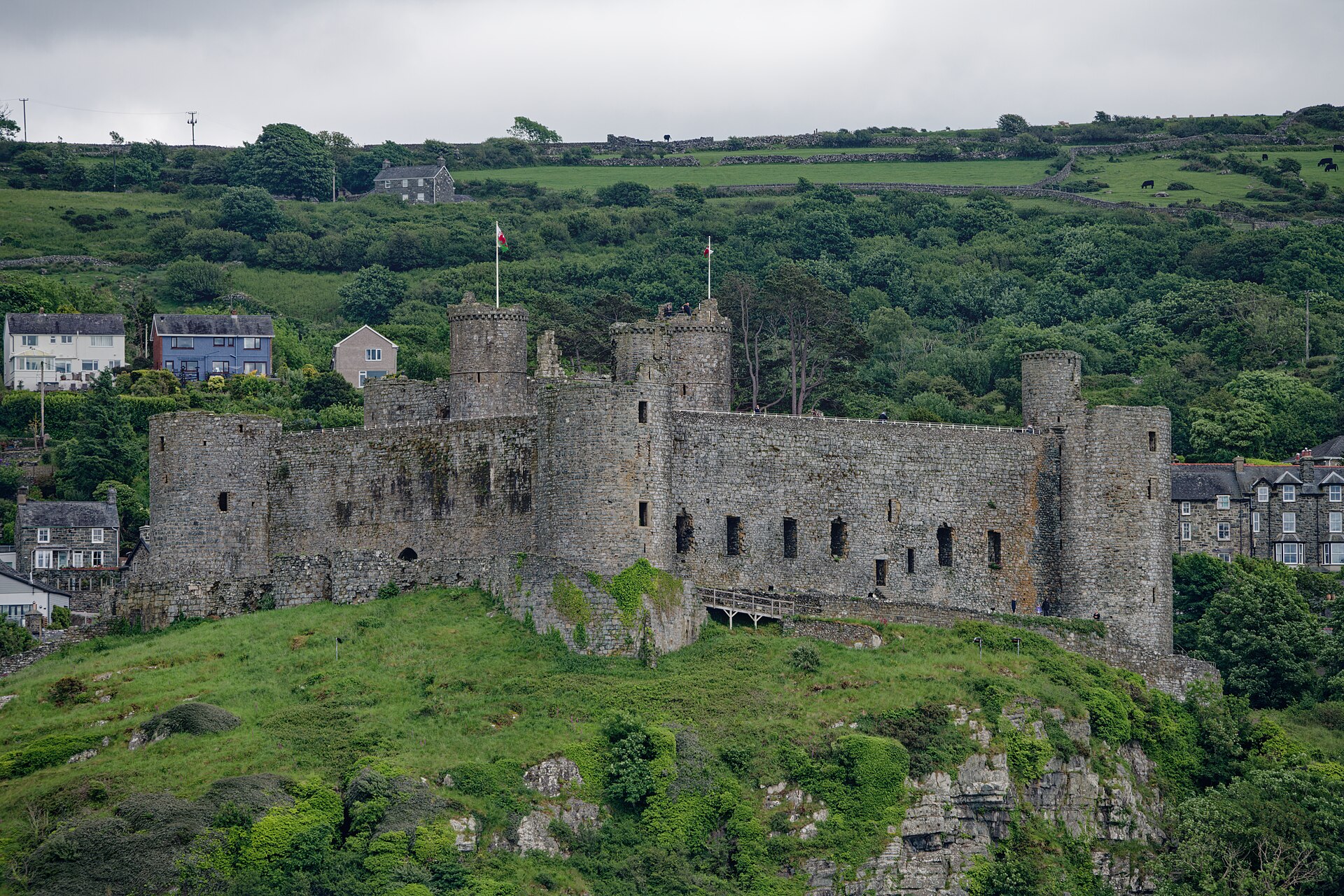
Edward I followed conquest with architecture. Around the heartland of Gwynedd he erected a chain of fortresses that remains among the most formidable programmes of castle-building in medieval Europe: Conwy, Caernarfon, Harlech, and Beaumaris, the last begun in 1295 and never quite completed. These were not merely military strongpoints but instruments of political domination, planted in the most sensitive ground of the conquered kingdom. The title Prince of Wales passed to the English heir apparent, a tradition established for Edward’s son, born at Caernarfon in 1284. Yet Gwynedd’s legacy proved harder to extinguish than its rulers. The arms of the house of Aberffraw, quarterly or and gules with four lions passant guardant counterchanged, survived as the royal badge of Wales and are borne to this day on the arms of the Prince of Wales. A century after the conquest, Owain Glyndŵr, proclaiming himself Prince of Wales in 1400, drew on that same tradition to lead the last great rising of the Welsh, a rebellion that came close enough to success to alarm the English crown before Owain vanished from the record around 1415, undefeated but unrealised. The native principality was never restored; the memory of Aberffraw endures.
The Princes of Gwynedd, Succession
The house of Aberffraw traced descent from Cunedda and, through Rhodri Mawr, produced the dominant dynasty of medieval Wales. The succession is given in two phases: the earlier kings and the princes who bore the title Prince of Wales, concluding with Owain Glyndŵr as a separate coda to the native tradition.
Kings and Princes of Gwynedd
- — Rhodri MawrRhodri the Great; united Gwynedd, Powys, and much of south-west Wales; killed 878. The dynasty’s founding figure in the mature tradition.
- — Gruffudd ap CynanRestored the line after Norman encroachment; imprisoned for years at Chester before reclaiming his inheritance; died 1137, having ruled Gwynedd for over forty years.
- — Owain GwyneddSon of Gruffudd ap Cynan; first to style himself Prince of the Welsh; resisted Henry II; died 1170.
- — Llywelyn ab IorwerthLlywelyn the Great; dominated Wales as a near-sovereign; court at Abergwyngregyn; married Joan, daughter of King John; died 1240.
- — Dafydd ap LlywelynSon of Llywelyn the Great; first Welsh ruler to use the title Prince of Wales; died 1246 without a legitimate heir, leaving the succession disputed.
Princes of Wales (native line)
- — Llywelyn ap GruffuddLlywelyn the Last; recognised as Prince of Wales by the Treaty of Montgomery, 1267; killed near Builth Wells, December 1282. The last native Prince of Wales.
- — Dafydd ap GruffuddBrother of Llywelyn the Last; briefly styled Prince of Wales after Llywelyn’s death; captured and executed at Shrewsbury, 1283 -- the first man hanged, drawn and quartered for treason in English record.
- — Owain GlyndŵrNot of the Aberffraw line but inheritor of its tradition; proclaimed Prince of Wales 1400; led the last great Welsh revolt; vanished from the record c. 1415, never captured, never formally defeated.
The lions of Aberffraw
The native principality of Gwynedd ended not with a treaty or a surrender but with a battlefield death and an execution on the scaffold at Shrewsbury. Llywelyn ap Gruffudd and his brother Dafydd had staked everything on the last revolt, and lost. Edward I’s castles sealed the conquest in stone. Yet the house of Aberffraw left a mark on Wales that no military victory could wholly erase. The four golden and red lions of Gwynedd outlived the dynasty that bore them, becoming in time the badge of Wales itself: the emblem of a kingdom remembered, if not restored.