Three Centuries of Autocracy
The House of Romanov
Tsars and Emperors of Russia
When the Assembly of the Land met in Moscow in February 1613 and elected the sixteen-year-old Michael Romanov as Tsar of All Russia, it was not choosing greatness so much as choosing survival. The country had endured two decades of famine, civil war, foreign invasion and competing claimants to the throne. The Romanovs were not the most powerful family in Moscow; they were among the most acceptable. From that unpromising foundation, over three centuries, they built one of the largest empires the world has seen, and lost it in a week.
The Time of Troubles and the election of Michael
The Romanovs were an ancient Muscovite boyar family, their fortunes tied to the old Rurikid dynasty through Anastasia Romanovna, the first wife of Ivan the Terrible. When Ivan’s son Fyodor died in 1598 without an heir, the main dynastic line ended and Russia entered the Time of Troubles: a period of contested succession, famine so severe that perhaps a third of the population perished, Polish and Swedish intervention, and the occupation of Moscow itself.
By 1613 the foreign garrisons had been expelled by a popular militia, and a national assembly was convened to choose a new tsar. The choice of Michael Romanov, young and politically unthreatening, was partly an act of exhaustion and partly a recognition that his family’s connection to the old dynasty gave the new reign a degree of legitimacy. His father, the Patriarch Filaret, effectively governed on his behalf until his own death in 1633. The dynasty had begun, but it had begun modestly.
Peter the Great and the making of an empire
The Romanov who remade everything was Peter I, who came to sole power in 1694 and reigned until 1725. Peter had spent time incognito in the shipyards of the Dutch Republic and England, absorbing what he saw, and he returned to Russia with an agenda that brooked no argument: the country would modernise, or he would break it doing so. He created a navy, built a European-style army, established new administrative structures on Western models and dragged the Russian church under firmer state control.
In 1703 he founded St Petersburg on a Baltic marsh seized from Sweden, intending it as a window on Europe and eventually moving the capital there. In 1721, after the decisive defeat of Charles XII of Sweden at Poltava in 1709 had confirmed Russian dominance of the Baltic, Peter proclaimed the Russian Empire and adopted the title Emperor. The old tsardom of Muscovy had become something larger and, by its own reckoning, more formidable. Peter died in 1725, having transformed his country out of all recognition and having executed his own son Alexei for alleged conspiracy against him.
The succession after Peter was turbulent. Four empresses and two tsars came and went in the four decades after his death, their reigns frequently decided by palace coups with the support of the guard regiments. Stability returned, after a fashion, with Elizabeth I, who reigned from 1741 to 1762.
Catherine the Great and the height of the empire
In 1762 Peter III, the German-born grandson of Peter the Great, was deposed and killed in a coup led by his own wife, a German princess who became Catherine II and whom history calls Catherine the Great. The old Romanov male line had in fact died out with Elizabeth; from 1762 the dynasty that sat on the Russian throne was properly the House of Holstein-Gottorp-Romanov, though it continued to call itself Romanov and was recognised as such.
Catherine reigned from 1762 to 1796 and extended the empire further than any ruler since Peter. She annexed much of Poland in three successive partitions, expanded into the Ottoman territories around the Black Sea, and took Crimea in 1783. She corresponded with Voltaire and Diderot, founded the Hermitage Museum and styled herself an enlightened sovereign, though the emancipation of the serfs remained, conspicuously, beyond her programme. Her reign is the apogee of the Romanov empire as a cultural and territorial power.
Napoleon, the Tsar Liberator and assassination
Alexander I inherited the throne in 1801 after the murder of his father Paul I, in which he was at minimum complicit. He faced the defining challenge of his age: Napoleon. After early defeats, Russia absorbed the French invasion of 1812, aided by an early winter and the scorched-earth withdrawal that stripped the Grande Armée of every kind of supply. Napoleon reached Moscow to find it burning; he retreated through snow with a catastrophic loss of men and material. Alexander led the allied coalition into Paris in 1814 and played a significant part in the post-war settlement at the Congress of Vienna.
The reign of Alexander II brought the greatest domestic transformation the empire had yet seen. The Crimean War of 1853 to 1856 had exposed the military and economic backwardness of Russia before the industrial powers of Western Europe, and Alexander drew the obvious conclusion. In 1861 he emancipated the serfs: some twenty-three million people bound to the land were legally freed, earning him the title Tsar Liberator. The emancipation was partial and its implementation deeply flawed, but it was the largest social reform in Russian history. In March 1881, after six assassination attempts, a bomb thrown by revolutionaries of the Narodnaya Volya killed him on the streets of St Petersburg. His son Alexander III, a convinced reactionary, cancelled the constitutional reforms his father had been considering on the morning of his death.
Nicholas II and the end of the dynasty
Nicholas II came to the throne in 1894. He was conscientious, devoted to his family and wholly unsuited to the role he had inherited. The empire he governed faced simultaneous pressure from industrial unrest, revolutionary politics, agrarian crisis and military overstretching. The humiliating defeat by Japan in 1904 to 1905 triggered the revolution of 1905, which forced Nicholas to grant a constitution and establish the Duma. He spent the next decade trying to limit what he had conceded.
The First World War was the end. Russia mobilised on a vast scale and suffered losses proportionate to the scale. By 1917 the supply system had broken down, the army was exhausted, and the cities were hungry. In March 1917 strikes in Petrograd grew into a revolution; the garrison mutinied rather than suppress it. Nicholas abdicated on 15 March 1917, and the three-hundred-year dynasty ended without a formal battle for the throne.
The Provisional Government held Nicholas and his family under arrest. After the Bolshevik seizure of power in October 1917, the family was moved east to Yekaterinburg in the Urals. On the night of 16 to 17 July 1918, as White Army forces approached the city, Nicholas, his wife Alexandra, their five children and four servants were shot and bayoneted in the basement of the Ipatiev House on the orders of the local Bolshevik Soviet, acting with the knowledge of Moscow. Nicholas was forty-nine. His youngest child, the Tsarevich Alexei, was thirteen. The Russian Orthodox Church canonised the family in 2000.
Arms, seats and the succession dispute today
The arms most closely identified with the Russian Empire were not originally Romanov arms at all. The double-headed eagle, Or, a double-headed eagle displayed sable, crowned, bearing orb and sceptre, was adopted by Ivan III of Moscow after the fall of Constantinople in 1453, as the Grand Duchy of Moscow presented itself as the heir to the Eastern Roman Empire. The eagle became the central element of the Russian imperial coat of arms, elaborated over the centuries into a composition of great complexity. The specific Romanov family arms, granted in 1856, showed a silver griffin on a red field, distinct from the imperial emblem but seldom used in isolation. The empire’s motto was "God is with us".
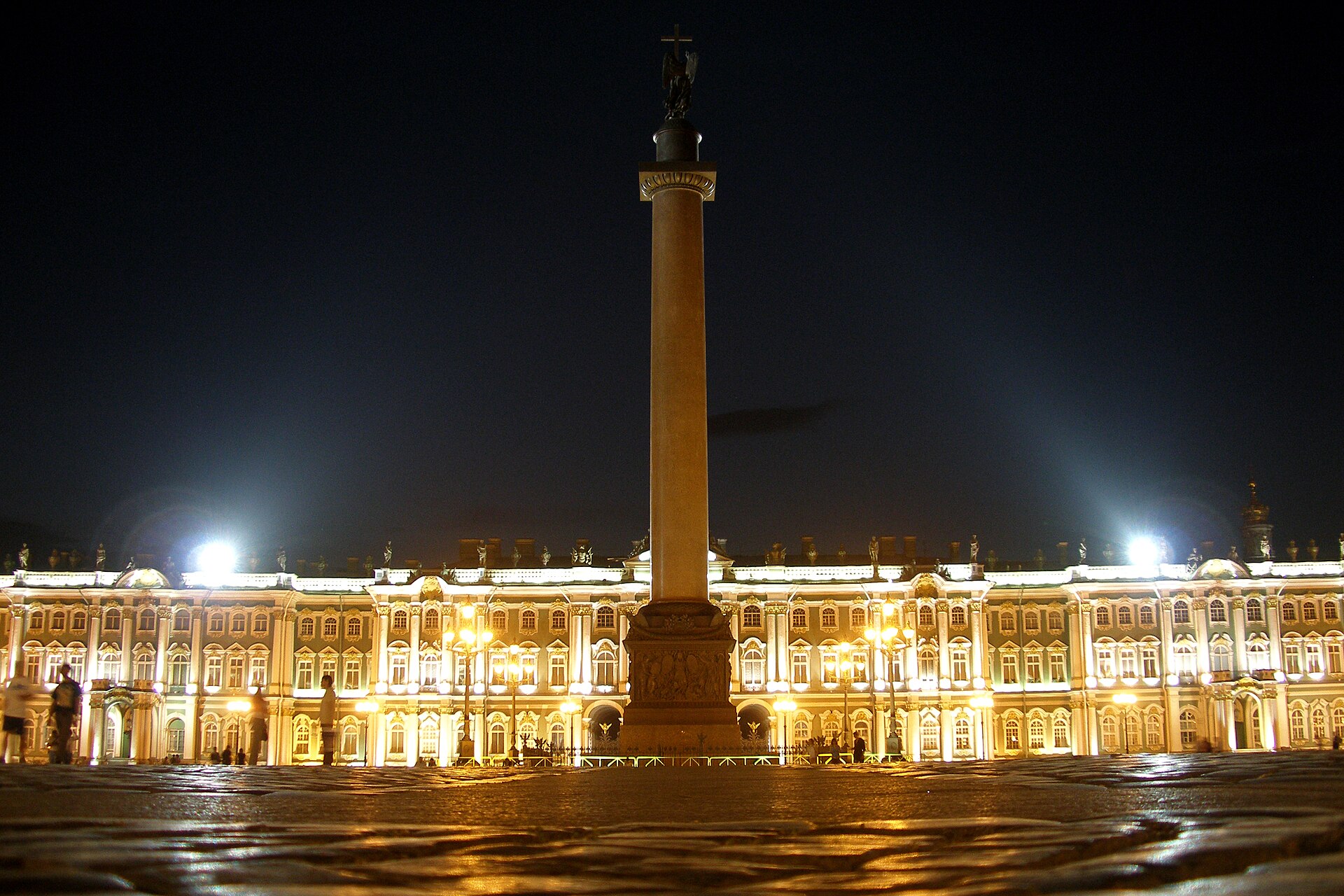
The principal seats of the dynasty were the Kremlin in Moscow, the Winter Palace in St Petersburg, and the Catherine Palace at Tsarskoye Selo, the vast baroque ensemble that served as the preferred summer residence of the later Romanovs. All three survive, the Winter Palace and Catherine Palace now operating as museums under the Russian state.
The headship of the house today is contested. The Kirillovich line, descended from Grand Duke Kirill Vladimirovich who declared himself Curator of the Russian Throne in 1924, is represented by Grand Duchess Maria Vladimirovna, born in 1953, and her son George Mikhailovich, born in 1981. Maria styles herself head of the Imperial House of Russia. The Romanov Family Association, which groups the wider Romanov kinship, declines to recognise her claim and does not name a head of the house, arguing that the dynastic rules governing succession were not properly observed by the Kirillovich line. The dispute has not been resolved and shows no sign of resolution.
The House of Romanov, Succession
The Romanov succession runs from the election of Michael I in 1613 through the tsars and emperors of Russia to the abdication of Nicholas II in 1917 and the disputed headship of the house today.
Tsars and Emperors
- — Michael I, first Romanov TsarElected Tsar by the Assembly of the Land in February 1613; aged sixteen at his accession; his father Patriarch Filaret governed as co-ruler until 1633; d. 1645.
- — Alexis ITsar 1645--1676; father of Peter the Great; consolidated the dynasty and expanded the empire southward and eastward; issued the law code of 1649 that bound the serfs to the land more tightly than before.
- — Peter the Great, first EmperorTsar from 1682, Emperor from 1721; westernised Russia, founded St Petersburg in 1703, defeated Sweden at Poltava and proclaimed the Russian Empire; d. 1725.
- — Catherine the GreatEmpress 1762--1796; deposed her husband Peter III; extended the empire around the Black Sea and into Poland; the dynasty continued as Holstein-Gottorp-Romanov from this point; d. 1796.
- — Alexander IEmperor 1801--1825; led the allied coalition that defeated Napoleon; Russia’s scorched-earth withdrawal in 1812 destroyed the Grande Armée; represented Russia at the Congress of Vienna.
- — Alexander II, the Tsar LiberatorEmperor 1855--1881; emancipated the serfs in 1861; assassinated in St Petersburg by Narodnaya Volya revolutionaries on 13 March 1881.
- — Nicholas II, last TsarEmperor 1894--1917; abdicated 15 March 1917 during the February Revolution; executed with his entire family at Yekaterinburg on the night of 16--17 July 1918; canonised by the Russian Orthodox Church in 2000.
The disputed succession
- — Grand Duchess Maria Vladimirovna (Kirillovich claimant)B. 1953; daughter of Grand Duke Vladimir Kirillovich; styles herself head of the Imperial House of Russia; her claim is contested by the Romanov Family Association.
- — The disputed succession todayThe Romanov Family Association does not recognise the Kirillovich claim and declines to name a head of the house. The dispute turns on whether dynastic succession rules were observed by the Kirillovich line; it has not been resolved.
Elected in crisis, ended in a basement
The Romanov dynasty began with an act of collective desperation, a country choosing the least dangerous option available after a generation of catastrophe, and it ended with an act of calculated brutality in a locked room in the Urals. In between those two moments, three centuries of autocratic rule shaped the largest country on earth, built one of the great European capitals from nothing, and produced, in Peter and Catherine, two of the most formidable rulers of the modern age. What the dynasty could not do was adapt quickly enough to the pressures of the twentieth century: the mass army, the industrial city, the organised political party. When those forces combined in the spring of 1917, the empire dissolved in days. The buildings remain. Visitors walk through the Winter Palace and the Catherine Palace every year. The house that filled them is gone.