Kings of Prussia, German Emperors
The House of Hohenzollern
From a Swabian Castle to the German Throne
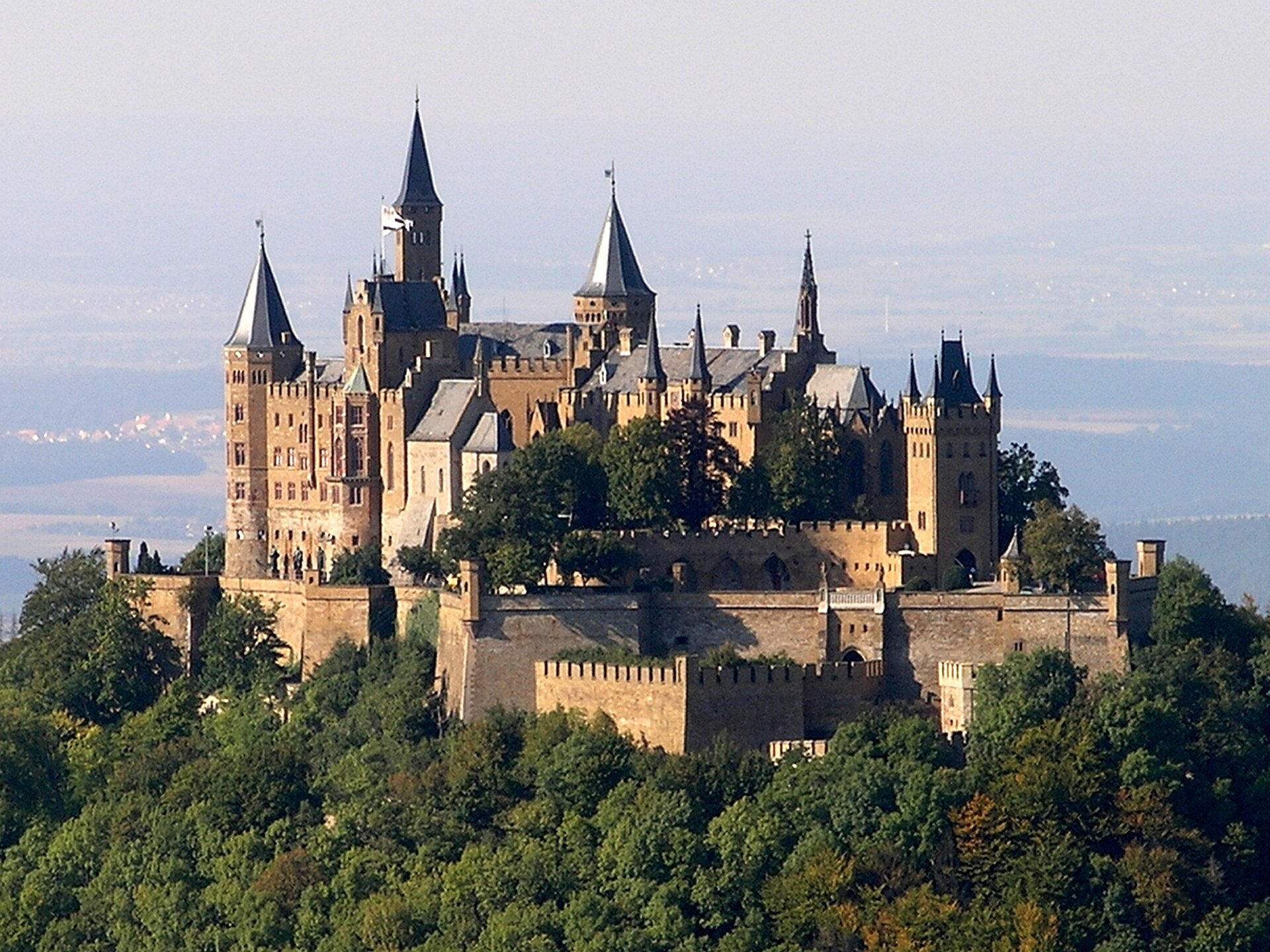
Few dynasties in European history mapped out so long a climb. The Hohenzollerns began as counts of a castle in the Swabian hills, accumulating lands and offices across the centuries until a single act of Protestant ambition placed them in Brandenburg, and from Brandenburg they pressed north and east until their margravate had swallowed a Baltic duchy and their ruler had crowned himself a king. By 1871 the head of the house stood in the Hall of Mirrors at Versailles and received the title of German Emperor. Fifty years later it was over. But the arc from that Swabian hilltop to the palaces of Potsdam is one of the more remarkable stories European history has to tell.
The castle on the ridge
The family takes its name from Hohenzollern Castle, a fortress perched on a ridge in Swabia in what is now Baden-Württemberg. The first recorded ancestor is Burkhard I, count of Zollern, noted in a document of 1061. For the next century and a half the family were a middling Swabian dynasty, acquiring lands and titles in the patient manner of the age but making no extraordinary mark on imperial affairs.
In 1214 the house divided into two branches that would follow entirely separate destinies. The elder Swabian line remained Catholic and confined to the south. The younger Franconian line moved to the Rhineland, cultivated its connections with the Hohenstaufen and later the Hohenzollern burgraves of Nuremberg, and positioned itself for the opportunity that came two centuries later.
Brandenburg and the Franconian inheritance
The transforming moment arrived in 1415, when the Holy Roman Emperor Sigismund granted the Electorate of Brandenburg to Frederick of Hohenzollern, Burgrave of Nuremberg, in recognition of loyal and expensive service. Frederick I became Elector of Brandenburg, and his descendants would never willingly relinquish the prize. The electorate was not obviously valuable: it was a sandy, thinly settled march on the eastern edge of the empire, exposed on every side. The Hohenzollerns set about making it more than it looked.
The critical transformation came under Frederick William, the Great Elector, who ruled from 1640 to 1688. Inheriting a state devastated by the Thirty Years’ War, he rebuilt its finances, forged a standing professional army and established the bureaucratic machinery that would underpin Hohenzollern power for two centuries. He drove the Swedes from his territory, secured favourable terms at the Peace of Saint-Germain-en-Laye and, by the time he died, had turned Brandenburg-Prussia into a power that its neighbours took seriously.
A kingdom won and a great power made
In 1701 the Great Elector’s son Frederick III negotiated a remarkable prize from the Emperor Leopold I: the right to crown himself king, in exchange for military support. On 18 January 1701, at Königsberg, Frederick placed a crown on his own head and styled himself Frederick I, King in Prussia. The careful phrasing was diplomatic; the substance was not. The Hohenzollerns were now royalty.
The dynasty’s full ambition became clear under Frederick II, known to history as Frederick the Great. Inheriting the throne in 1740, he launched a surprise invasion of Habsburg Silesia within months, precipitating the War of the Austrian Succession. Despite the odds and the coalition ranged against him, Frederick held Silesia through two long wars, including the Seven Years’ War in which Prussia faced France, Austria and Russia simultaneously. He did not merely survive: by 1763 Prussia was recognised as one of the great powers of Europe, and Frederick was the most admired sovereign on the continent. He died in 1786, having transformed his inheritance out of all recognition.
The German Empire and its end
The final act of Hohenzollern ascent came from French miscalculation. The Franco-Prussian War of 1870 to 1871, provoked in part by Bismarck’s manipulation of the Ems Dispatch, ended in a swift Prussian triumph. France sued for terms. On 18 January 1871, in the Hall of Mirrors at the Palace of Versailles, the assembled German princes proclaimed Wilhelm I the first German Emperor. Bismarck, his chancellor, had engineered it; but the crown rested on a Hohenzollern head.
The empire Wilhelm I founded lasted forty-seven years. His grandson Wilhelm II came to the throne in 1888 and dismissed Bismarck two years later, steering a course that combined personal vanity, imperial overreach and diplomatic recklessness. The First World War brought everything down. On 9 November 1918, two days before the armistice, Wilhelm II abdicated both the German imperial throne and the Prussian crown, crossed into the Netherlands and never returned. He died at Doorn in 1941.
A Swabian branch and a Romanian throne
The elder Swabian line, which had separated from the Franconian branch in 1214, produced a junior house whose story took an unexpected turn. The Hohenzollern-Sigmaringen branch supplied a candidate when the new Kingdom of Romania required a foreign prince to lend it dynastic respectability. In 1866 Karl of Hohenzollern-Sigmaringen became the reigning Prince of Romania, and in 1881 he was proclaimed Carol I, the first King of Romania. His successors -- Ferdinand I, Carol II and Michael I -- reigned until 1947, when the communist regime forced Michael to abdicate. The Sigmaringen line gave Catholic southern Germany and Orthodox Romania an unexpected dynastic connection.
Arms, motto and the house today
The patrimonial arms of the Hohenzollern house are Quarterly argent and sable, the silver-and-black quartering that identifies the ancestral Zollern line. The Prussian state displayed a black eagle on a white field -- the arms of the kingdom rather than the dynasty -- but the silver and black quartering has remained the characteristic mark of the house itself. The family motto is Nihil sine Deo, "Nothing without God."
Their principal historical seats include the rebuilt Hohenzollern Castle in Swabia, which continues to draw visitors to its ridge above the Swabian Alb, and the palaces of Berlin and Potsdam, above all Sanssouci, the intimate summer retreat that Frederick the Great preferred to any grander residence. Sanssouci is now administered by the Prussian Palaces and Gardens Foundation.
The house did not dissolve with the empire. Georg Friedrich, Prince of Prussia, born in 1976, is the current head of the house and great-great-grandson of Wilhelm II. He leads a family that retains a public profile and has pursued, with mixed results, legal claims to some properties held by the German state. He is not reigning, but the line continues.
The House of Hohenzollern, Succession
The Hohenzollern succession runs from the first Elector of Brandenburg in 1415 through the Kings of Prussia to the German Emperors and the present head of the house. The entries below follow the Franconian-Brandenburg-Prussian line.
Electors of Brandenburg
- — Frederick I, Elector of BrandenburgGranted the Electorate of Brandenburg by Emperor Sigismund in 1415; Burgrave of Nuremberg; founder of the Hohenzollern line in Brandenburg.
- — Frederick William, the Great ElectorElector of Brandenburg 1640--1688; rebuilt the state after the Thirty Years’ War; created the standing army and bureaucracy that underpinned Hohenzollern power; d. 1688.
Kings and Emperors
- — Frederick I, King in PrussiaElector Frederick III of Brandenburg; crowned himself King in Prussia at Königsberg on 18 January 1701; the first Hohenzollern king; d. 1713.
- — Frederick II (Frederick the Great)King of Prussia 1740--1786; seized Silesia from Austria; survived the Seven Years’ War against France, Austria and Russia; made Prussia a great power.
- — Wilhelm I, German EmperorKing of Prussia from 1861; first German Emperor, proclaimed at Versailles 18 January 1871; d. 1888.
- — Wilhelm II, the last KaiserGerman Emperor and King of Prussia 1888--1918; dismissed Bismarck in 1890; abdicated on 9 November 1918; died in exile at Doorn, Netherlands, 1941.
- — Georg Friedrich, Prince of PrussiaPresent head of the House of Hohenzollern; b. 1976; great-great-grandson of Wilhelm II; not reigning.
From sandy march to imperial throne
The Hohenzollern story is one of relentless institutional building: the army the Great Elector created, the bureaucracy his successors refined, the diplomatic nerve Frederick the Great displayed at the lowest moments of the Seven Years’ War. These were the foundations on which an empire was eventually raised. When it fell, in November 1918, it fell quickly, as empires built on military strength can do when the armies stop winning. What remains is Hohenzollern Castle on its Swabian ridge, Sanssouci in its gardens, and a dynasty that climbed farther than almost anyone in 1061 could have imagined.