A Great Highland Clan
Lord Lovat
Clan Fraser of the Aird
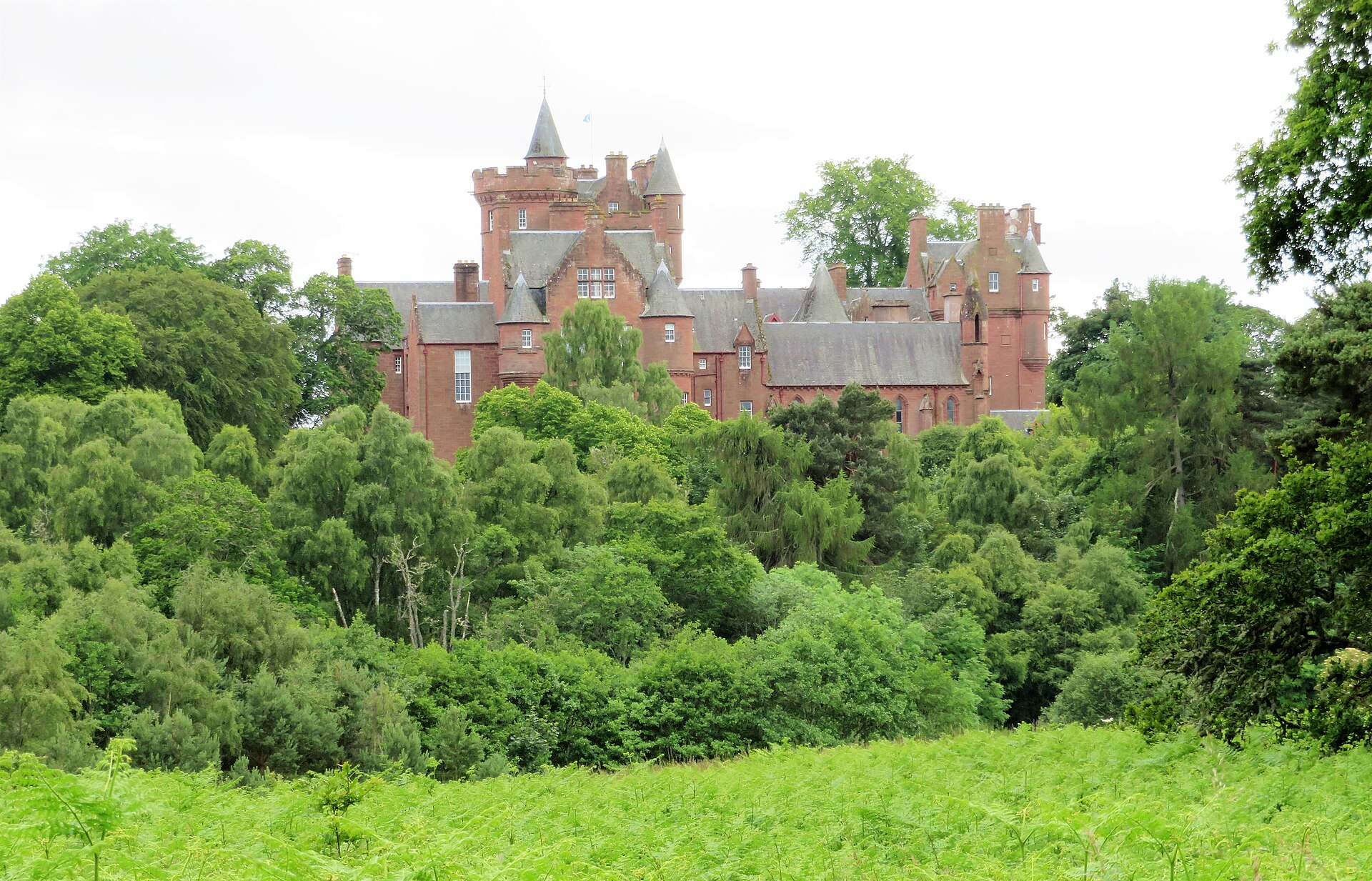
No Highland clan has packed more drama into its centuries than the Frasers of Lovat. From their stronghold in the Aird along the Beauly Firth they fought their neighbours, schemed at the edge of treason, sent men to die on a dozen battlefields, and produced in the eighteenth century the most notorious Jacobite peer in Scotland. Their arms carry three strawberry-flowers, and their motto is Je suis prest: “I am ready.” The history of the clan is proof enough that the words were not empty.
Norman origins and the strawberry-flower
The Frasers trace their name and their emblem to Normandy. The family appears in Scotland from the twelfth century, when they followed the Anglo-Norman settlers invited by the Scottish kings to strengthen the feudal order. Their very name is bound up with their arms: the fraise, the heraldic cinquefoil that resembles a strawberry-flower, gave the clan both its symbol and, in the most plausible etymology, its surname. Whether the name preceded the charge or the other way about, the three fraises argent on a blue field became one of the most recognisable blazons in Scottish heraldry.
The Lovat line settled in the Aird, the broad peninsula between the Beauly Firth and Loch Ness, and in the land around Beauly in Inverness-shire. There they built their power across the fourteenth and fifteenth centuries, acquiring through marriage and grant the lordship that the Peerage of Scotland would eventually formalise. The title Lord Lovat was created in the Peerage of Scotland around 1464, making the Frasers one of the great Highland noble houses of the later medieval period.
The Battle of the Shirts
In the summer of 1544 the Great Glen became the scene of one of the bloodiest clan encounters in Scottish memory. The Frasers under Hugh, 3rd Lord Lovat, clashed with Clanranald on the shores of Loch Lochy in a combat so ferocious that the men stripped to their shirts in the summer heat before fighting. Blàr na Léine, the Battle of the Shirts, left the field strewn with the dead of both clans. Lord Lovat himself was killed alongside his heir, a catastrophic double loss that struck at the heart of Fraser power in the Highlands.
The battle illustrated the dangerous world the Highland lords inhabited: a landscape of ancient grudges, competing land claims, and alliances that shifted with each season. The Frasers recovered, as great clans did, but the memory of the Shirts was long, and the name of the fight endured in Gaelic tradition as a byword for the savagery a clan feud could reach.
The Old Fox: Simon Fraser, 11th Lord Lovat
No figure in the long history of the lordship casts a longer shadow than Simon Fraser, 11th Lord Lovat. Born around 1667, he spent decades weaving intrigue with a skill that earned him the name “the Old Fox”: he courted the Jacobite cause, negotiated with the Hanoverian government, and then courted the Jacobites again, always calculating the safest position for himself and his clan. His record of duplicity was remarkable even by the standards of an age in which Highland lords were expected to hedge their bets between the exiled Stuarts and the reigning crown.
When the rising of 1745 came, Lovat committed Fraser men to the Jacobite army under Prince Charles Edward Stuart while maintaining a pretence of loyalty to the government. His calculations failed. After Culloden in 1746 he was hunted down, brought south, and tried for high treason. The Old Fox was convicted and beheaded on Tower Hill on 9 April 1747. He was the last man to be publicly beheaded in Britain, and he met his end with a composure that the London crowd, which had gathered in thousands, found as infuriating as it was impressive. He was eighty years old.
The Fraser Highlanders and the road to Quebec
The attainder that followed the execution stripped the title from the family, but it did not strip the family from the Highlands. Simon’s son, also Simon, set about rebuilding the family’s position through the one route open to attainted Jacobite heirs: military service to the crown. In 1757 he raised the 78th Regiment of Foot, known as Fraser’s Highlanders, drawing on the tenantry and loyalty of the Lovat estates to fill its ranks.
The regiment served under General James Wolfe in the campaign that ended French power in North America. Fraser Highlanders scaled the cliffs below the Plains of Abraham at Quebec in the night of 12 September 1759 and were in the line when Wolfe fell and Montcalm’s army broke. The victory at Quebec, and the conspicuous part Fraser’s men played in it, rehabilitated the family in the eyes of the crown. The title Lord Lovat was restored in 1854.
The Lovat Scouts and the making of a sniper corps
The 14th Lord Lovat raised a corps of Highland stalkers and gamekeepers for service in the Second Boer War and in 1900 formed the Lovat Scouts, the British Army’s first dedicated sniper unit. These men, trained in fieldcraft on the deer forests of the Highlands, brought skills no conventional soldier possessed: the ability to move without being seen, to read ground at long range, and to shoot with precision from concealment. The Scouts served in South Africa, in the Dardanelles, and in the First World War, and their founding established a tradition of unconventional warfare within the British military that would reach its fullest expression in the next generation.
Sword Beach and the piper
On 6 June 1944 the 15th Lord Lovat, Simon “Shimi” Fraser, led No. 4 Commando Brigade ashore at Sword Beach in Normandy. He had ordered his piper, Bill Millin, to play as the landing craft came in under fire. Millin played “Highland Laddie” as the ramp went down and the men waded through the surf; he continued playing on the beach while the brigade reorganised under German fire. The image of the tall Lovat striding through the shallows with a rifle in one hand while his piper played beside him became one of the most vivid of the entire Normandy landings.
The Germans who survived the battle later told Allied interrogators that they had not shot the piper because they assumed anyone playing bagpipes on a beach under fire must be mad. Lovat’s commandos pressed inland and reached Pegasus Bridge to relieve the 6th Airborne Division, arriving, famously, a few minutes late and apologising to the paratroopers who had held the bridge through the night. Lovat was wounded later in the campaign and survived the war. He died in 1995, the last of the great wartime commando leaders.
The Lords Lovat, Succession
The peerage was created in the Peerage of Scotland around 1464 and has been held by the chiefs of Clan Fraser of the Aird. The numbering is disputed: the peerage count, which includes the period of attainder, gives the present chief as the 16th Lord; the clan’s own traditional reckoning, which does not count the attainted title, makes him the 18th. The sequence below follows the peerage count.
Lords Lovat
- — Hugh Fraser, 1st Lord LovatTitle created in the Peerage of Scotland c. 1464; established the Fraser lordship in the Aird and around Beauly, Inverness-shire.
- — Hugh Fraser, 3rd Lord LovatKilled at Blàr na Léine (the Battle of the Shirts) on the shores of Loch Lochy, 1544, alongside his heir; the encounter with Clanranald was among the bloodiest clan battles of the period.
- — Simon Fraser, 11th Lord Lovat“The Old Fox”; Jacobite peer who played both sides through the risings of 1715 and 1745; convicted of high treason and beheaded on Tower Hill, 9 April 1747; the last man publicly beheaded in Britain.
- — Title attaintedThe lordship was forfeit under the attainder following the 11th Lord’s execution; the family retained the Lovat estates in the Highlands.
- — Title restored, 1854The attainder was reversed and the peerage restored; the rehabilitation reflected the family’s service to the crown, above all through Fraser’s Highlanders at Quebec in 1759.
- — Simon Fraser, 14th Lord LovatRaised the Lovat Scouts in 1900 for service in the Boer War; the British Army’s first dedicated sniper unit, drawn from Highland stalkers and gamekeepers.
- — Simon Fraser, 15th Lord Lovat“Shimi”; commanded No. 4 Commando Brigade ashore at Sword Beach, D-Day, 6 June 1944, with his piper Bill Millin playing beside him; wounded in Normandy; died 1995.
- — Simon Fraser, 16th Lord LovatBorn 1977; present chief of Clan Fraser of Lovat; succeeded his grandfather in 1995. Beaufort Castle, the family seat at Beauly, was sold in 1994 to meet death duties, though the Lovat estates remain in the family.
Three strawberry-flowers
The Frasers of Lovat have been ready, as their motto demands, for a very long time. Ready for the feuds of the Great Glen, for the calculated treacheries of the Jacobite age, for the cliffs below Quebec and the stalkers’ craft that built the first British sniper corps. Ready, above all, for a beach in Normandy where a piper played in the surf and a commando general strode ashore as though the whole bloody enterprise were a morning’s walk on the Lovat estates. The three fraises on their shield are modest charges for so turbulent a history. But the motto says everything: Je suis prest.