Britain’s Richest Dukes
The Duke of Westminster
Mayfair, Belgravia and the Grosvenor Estate
In 1677 a Cheshire baronet named Sir Thomas Grosvenor married a twelve-year-old heiress called Mary Davies and acquired, as part of her dowry, a tract of sodden meadow on the western edge of London known as the manor of Ebury. That single marriage remade a county family into the richest dukes in Britain. The fields became Mayfair, Belgravia and Pimlico; the long leases kept the freehold in Grosvenor hands; and when Queen Victoria created the 1st Duke of Westminster in 1874 she bestowed the last dukedom outside the royal family on a man who already owned more of London than almost anyone alive.
Norman origins and the Cheshire seat
The Grosvenors trace their ancestry to Gilbert le Gros Veneur, the great huntsman, a kinsman of William the Conqueror who came over at the Conquest. From that stock grew a family long settled in Cheshire, at the estate of Eaton in the broad meanders of the River Dee. The baronetcy dates from 1622, when James I raised the family to the new order Sir Francis Bacon had helped design. For the next half-century the Grosvenors were prosperous Cheshire gentry: well connected, modestly wealthy, and entirely unknown beyond their county.
Their Norman surname, meaning the great huntsman, survived intact across six centuries. The arms they eventually bore were drawn not from their own Norman heritage but from the Earls of Chester: Azure, a garb or, a gold wheatsheaf on blue, a symbol of the county that had made them. The motto chosen for the dukedom, Virtus non stemma, "Virtue, not ancestry", has a fine irony in a family whose entire fortune began with a genealogical gamble on a child bride’s inheritance.
The marriage that made a fortune
Mary Davies was the niece and heiress of Hugh Audley, a London money-scrivener who had acquired the manor of Ebury through a series of debt transactions. The manor covered some five hundred acres immediately to the west and north-west of the City of Westminster: ground that was, in 1677, little more than market gardens and marsh. Audley died in 1662 leaving the whole to his great-niece, then an infant.
When Sir Thomas Grosvenor secured the match he cannot have known quite what he was getting. London was growing fast, but the full transformation of Ebury into the most fashionable addresses in the world took another century. The crucial decision, taken by successive Grosvenor trustees in the eighteenth century, was to develop the estate on long ground leases rather than by selling the freehold. Builders erected the streets and squares; the Grosvenors retained the land beneath. When the leases fell in, the ground reverted. It was a mechanism for the permanent accumulation of wealth.
The rise through the peerage
The family climbed the peerage in steady steps as London grew around them. Richard Grosvenor became Baron Grosvenor in 1761, then Earl Grosvenor in 1784. Robert Grosvenor was advanced to Marquis of Westminster in 1831. The final step came in 1874, when Hugh Lupus Grosvenor received the dukedom from Queen Victoria. It was the last dukedom created outside the royal family: a fact that marks a boundary in English social history, separating the world of landed grandees from the age of democratic politics in which such creations became impossible.
Hugh Lupus, the 1st Duke, was a figure of Gladstonian grandeur: Master of the Horse, three times Lord Lieutenant of Cheshire, breeder of racehorses and Liberal politician. He rebuilt Eaton Hall on a scale that made it one of the largest houses in England. The Westminster title brought with it not only the Cheshire estate but the Reay Forest in Sutherland, adding Highland shooting to the portfolio of a family that had grown very rich indeed from urban ground rents.
Eaton Hall and the Cheshire estates
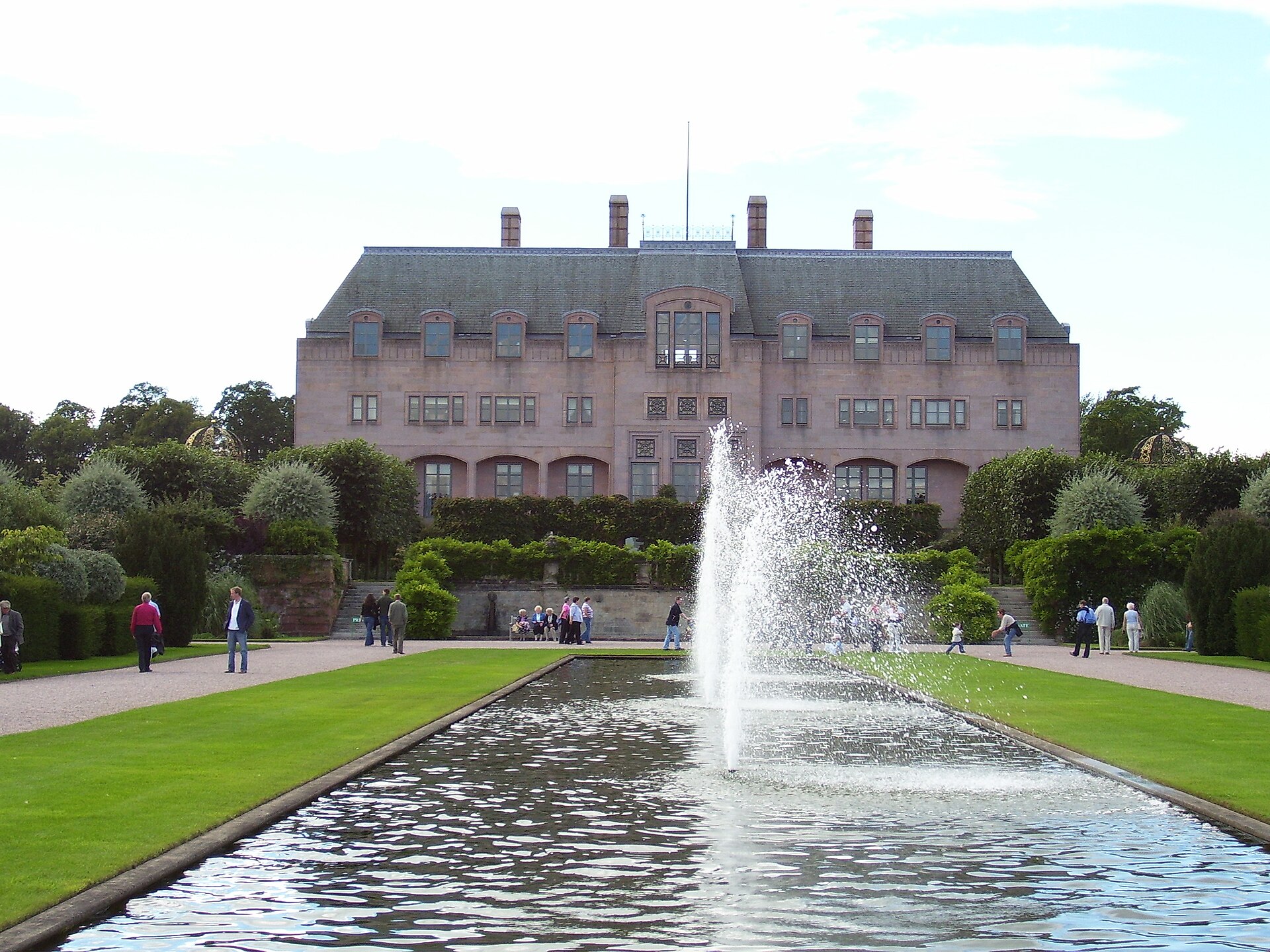
The family seat, Eaton Hall near Chester, has been rebuilt more than once. The Victorian palace of the 1st Duke was demolished in the 1960s; the present house, completed in 1973, is a modernist structure whose compact geometry stands in deliberate contrast to the park and gardens around it. For visitors expecting the pile that Hugh Lupus built, it comes as a surprise. For those who look at it as architecture on its own terms, it is a serious building: direct, unashamed, and almost entirely unlike the country houses that surround it.
The park, by contrast, retains its Victorian character: the bridge by William Porden, the stable block, the chapel by Waterhouse that survived demolition. The Cheshire estate remains the emotional and administrative centre of the family’s British holdings, even as the London property generates the greater part of its income.
The London estate today
The Grosvenor Group, the private property company through which the family manages its holdings, is among the largest property businesses in the world. Its London portfolio covers roughly 300 acres in Mayfair and Belgravia: streets of white stucco townhouses, hotels, embassies, and retail premises that represent the accumulated development of three centuries. Ground leases continue to fall in and be renegotiated; the estate office on Davies Street, itself on Grosvenor land, manages a ceaseless programme of refurbishment and renewal.
The group has diversified significantly beyond London: offices, retail and residential holdings in North America, continental Europe and Asia reduce dependence on any single market. But Belgravia and Mayfair remain the core, and the yield from that core remains extraordinary. When Forbes estimates the family fortune at upwards of ten billion pounds, the number rests ultimately on the ground beneath Eaton Square and Grosvenor Square, and on the decision, taken in the eighteenth century, never to sell it.
Hugh Grosvenor, 7th Duke of Westminster
The present Duke, Hugh Richard Louis Grosvenor, was born in 1991 and succeeded his father Gerald, the 6th Duke, in August 2016 at the age of twenty-five. Gerald died suddenly of a heart attack while at a friend’s estate in Lancashire; Hugh became, overnight, one of the wealthiest young men in Britain and chairman of the Grosvenor Group.
He was godfather to Prince George and a close friend of the Wales family. His elevation at so young an age placed the management of a global property empire on shoulders that had not expected to carry it so soon. By most accounts he has taken the responsibility steadily. The 7th Duke maintains Eaton Hall, continues the philanthropic programmes the family has run through the Westminster Foundation and related bodies, and has shown little appetite for the public profile that great wealth sometimes attracts.
The Dukes of Westminster, Succession
The dukedom was created in 1874. It was preceded by a baronetcy (1622), a barony (1761), an earldom (1784), and a marquisate (1831), all in the Grosvenor family and all of which merged in the dukedom.
Grosvenor of Eaton
- — Sir Thomas Grosvenor, 3rd BtMarried Mary Davies, heiress of the manor of Ebury, in 1677; the foundation of the London estate.
- — Sir Richard Grosvenor, 6th BtCreated Baron Grosvenor 1761; began development of Grosvenor Square.
- — Richard Grosvenor, 1st Earl GrosvenorCreated Earl Grosvenor 1784; extended the Mayfair and Belgravia developments.
- — Robert Grosvenor, 1st Marquis of WestminsterCreated Marquis of Westminster 1831; developed Belgravia in the 1820s and 1830s with builder Thomas Cubitt.
Dukes of Westminster
- — Hugh Lupus Grosvenor, 1st DukeCreated Duke of Westminster 1874 by Queen Victoria; the last dukedom conferred outside the royal family; rebuilt Eaton Hall.
- — Hugh William Grosvenor, 2nd DukeSucceeded 1899; died 1953; known for extravagant living and long yachting voyages; saw the estate through two world wars.
- — William Grosvenor, 3rd DukeSucceeded 1953; died 1963.
- — Gerald Grosvenor, 4th DukeSucceeded 1963; died 1967.
- — Robert Grosvenor, 5th DukeSucceeded 1967; died 1979; demolished the Victorian Eaton Hall.
- — Gerald Grosvenor, 6th DukeSucceeded 1979; died 2016; expanded the Grosvenor Group internationally.
- — Hugh Grosvenor, 7th DukeThe present Duke, succeeded 2016 at the age of 25; chairman of the Grosvenor Group; born 1991.
One marriage, four centuries of consequence
The story of the Westminster dukes is ultimately the story of a transaction: a Cheshire baronet, a child heiress, and five hundred acres of London marsh. That the marsh became the most valuable residential land in the world is a function of geography and timing that no one in 1677 could have foreseen. That the family kept it is a function of legal structure and professional management: the ground lease, the trust, the estate office, and latterly the global property group.
Norman blood, a county baronetcy, and a very good marriage: the Grosvenors had all three. The dukedom that resulted was the last of its kind in England, and the fortune that sustains it remains, four centuries after Mary Davies put her name to the settlement, among the largest assembled by any family in the world.