Lords of the English North
The Duke of Northumberland
The Percys of Alnwick
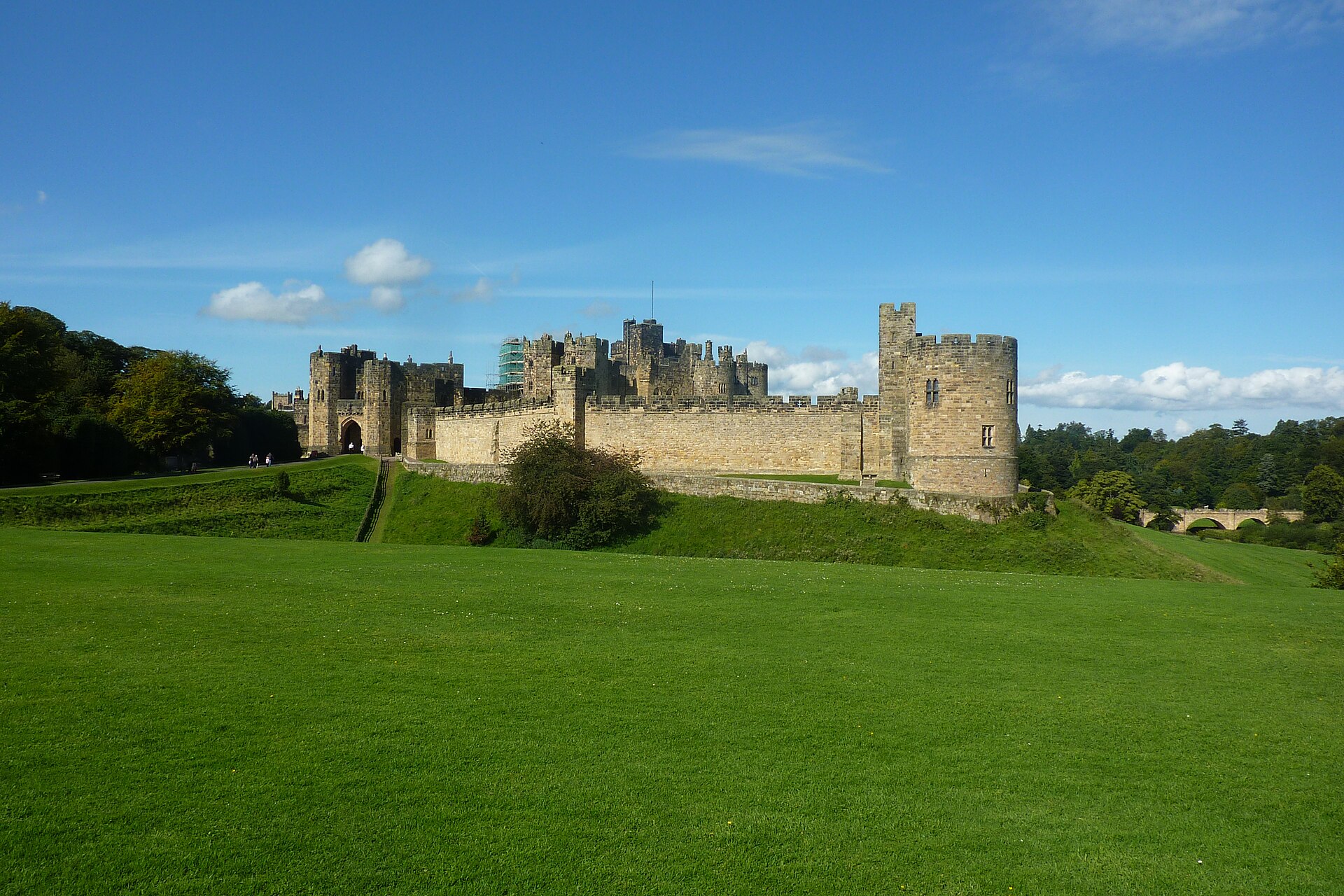
No family defined the English North as the Percys did. From their great castle at Alnwick they governed the border marches, raised armies for and against the Crown, and left their mark on the landscape, on the language of heraldry and on the plays of Shakespeare. Their story spans nearly a thousand years: from a Norman knight who crossed with the Conqueror to a living duke whose wife transformed the castle gardens into one of England’s most visited attractions.
The Normans on the Border
William de Percy came to England in the wake of the Conquest and received estates stretching from Yorkshire northwards. The family took its name from the village of Percy-en-Auge in Normandy, and within a generation it was among the most powerful baronial houses in the north of England. In 1309 Henry de Percy purchased Alnwick Castle in Northumberland, a strong fortress on the River Aln that had served as a defensive post against Scottish raids. That purchase planted the Percys permanently in the north.
The earldom of Northumberland was conferred on Henry Percy in 1377 by Richard II, setting the seal on a power the family had exercised in practice for generations. By the end of the fourteenth century the Percys were the paramount authority on the Anglo-Scottish border: wardens of the marches, commanders of border levies, and the men whom the Crown called upon whenever war threatened from the north.
Hotspur: Rebellion and Shakespeare
The most celebrated Percy of all never lived to inherit the earldom. Sir Henry Percy, nicknamed Hotspur for his fierce and restless energy, was the eldest son of the 1st Earl. He fought alongside his father against the Scots at Otterburn in 1388 and served the Crown in campaigns across England and Wales. But the Percys grew discontented with Henry IV, whom they had helped to the throne, and in 1403 Hotspur raised his standard in rebellion. He was killed at the Battle of Shrewsbury before the army his father was raising could join him. He was thirty-nine years old.
Shakespeare immortalised him in the two parts of Henry IV, setting him against the young Prince Hal in a rivalry that became one of the most celebrated contests in English drama. The playwright’s Hotspur is choleric, reckless and magnificent: a portrait that has outlasted every chronicle account and fixed the name Percy in the English imagination for ever.
The Wizard Earl and the Catholic North
The Percys were rarely far from trouble. The 7th Earl, Thomas Percy, led the Rising of the North in 1569, the great Catholic rebellion that aimed to depose Elizabeth I in favour of Mary Queen of Scots. The rising collapsed, and the Earl was captured and beheaded at York in 1572. His successor, the 8th Earl, died in the Tower, apparently by his own hand.
The 9th Earl, Henry Percy, fared little better. Known as the Wizard Earl for his scientific interests and his extensive library, he was imprisoned in the Tower for sixteen years on suspicion of complicity in the Gunpowder Plot of 1605. His cousin Thomas Percy was one of the conspirators. The earl himself was almost certainly innocent, but the government saw his connection to the plot as sufficient grounds for an enormous fine and indefinite confinement. He emerged at last in 1621, ruined in fortune but not in reputation, and spent his remaining years in scholarly retirement.
The Smithson Succession
The male Percy line eventually failed. The estates passed through a female heir, and in 1749 Sir Hugh Smithson, a Yorkshire baronet who had married Lady Elizabeth Seymour, great-granddaughter of the last Percy earl, took the name and arms of Percy by Act of Parliament. The transition was complete when George III created him 1st Duke of Northumberland in 1766, founding the line that continues today.
The 1st Duke had an extraordinary connection to the wider world. His illegitimate son James Smithson, born before the Percy marriage, became a distinguished chemist and mineralogist. On his death in 1829 Smithson left his fortune to the United States to found an establishment for the increase and diffusion of knowledge. That bequest created the Smithsonian Institution in Washington D.C., one of the world’s great museum complexes, and it bears the name of a man who was a Percy by adoption and an English nobleman’s bastard by birth.
Alnwick Castle and Syon House
The Percys hold two of England’s most distinguished houses. Alnwick Castle, their northern seat, has been continuously occupied and improved since 1309. Its medieval towers and state rooms now attract hundreds of thousands of visitors each year, partly because its exterior has served as Hogwarts School in the Harry Potter films. The Alnwick Garden, created from a walled wilderness by Jane Percy, Duchess of Northumberland, has become in its own right one of the country’s most celebrated designed landscapes, with a treehouse restaurant, poison garden and grand cascade.
Syon House in Middlesex, on the north bank of the Thames near Richmond, is the family’s London seat. The exterior is a severe late-medieval and Tudor shell, but the interior was remodelled by Robert Adam in the 1760s and is considered among his finest works in England: a sequence of state rooms whose variety of colour, ornament and spatial effect has been admired for two and a half centuries.
Arms, Motto and the Blue Lion
The Percy arms are among the most recognisable in English heraldry: Or, a lion rampant azure, a gold field charged with a blue lion. The blue lion derives not from a Percy but from the ancient Duchy of Louvain and Brabant, brought into the family’s shields by an early marriage alliance. It is quartered in the full achievement with the arms of Lucy, three luces or pike on a gold ground, recalling another medieval inheritance.
The motto is Esperance en Dieu, "Hope in God", a phrase that has appeared on Percy shields and documents for at least five centuries. It is an appropriate watchword for a family that survived rebellion, attainder, religious persecution, imprisonment and the extinction of its direct male line, and still holds its castle and its dukedom today.
The Earls and Dukes of Northumberland, Succession
The earldom was created in 1377; the dukedom in 1766 for the Smithson-Percy line. Earlier earldoms of 1377 passed through several creations before the male line failed.
Earls of Northumberland
- — Henry Percy, 1st Earl of NorthumberlandCreated Earl 1377 by Richard II; father of Hotspur; died 1408 after renewed rebellion.
- — Sir Henry Percy ("Hotspur")Eldest son of the 1st Earl; killed at the Battle of Shrewsbury, 1403, before he could inherit; immortalised by Shakespeare.
- — Henry Percy, 2nd Earl of NorthumberlandGrandson of the 1st Earl; killed at the First Battle of St Albans, 1455.
- — Henry Percy, 7th Earl of NorthumberlandLed the Rising of the North, 1569; captured and beheaded at York, 1572.
- — Henry Percy, 9th Earl of Northumberland"The Wizard Earl"; imprisoned in the Tower 1605–1621 over the Gunpowder Plot; scholar and patron of science; died 1632.
Dukes of Northumberland
- — Hugh Percy, 1st Duke of NorthumberlandBorn Hugh Smithson; took the name Percy in 1749 on marrying the Percy heiress; created 1st Duke 1766; father of James Smithson, founder of the Smithsonian Institution.
- — Hugh Percy, 2nd Duke of NorthumberlandBritish general in the American Revolutionary War; succeeded 1786; died 1817.
- — Hugh Percy, 3rd Duke of NorthumberlandLord Lieutenant of Ireland; succeeded 1817; died 1847.
- — Algernon Percy, 4th Duke of NorthumberlandFirst Lord of the Admiralty; succeeded 1847; died 1865.
- — Henry Percy, 7th Duke of NorthumberlandSucceeded 1918; died 1930.
- — Hugh Percy, 10th Duke of NorthumberlandSucceeded 1988; died 1995.
- — Ralph Percy, 12th Duke of NorthumberlandBorn 1956; succeeded 1995; his wife Jane, Duchess of Northumberland, created the Alnwick Garden.
The Northern Lords Endure
The Percys have outlasted almost everything that history has thrown at them: scaffold, tower, attainder and the failure of the male line. They governed the Anglo-Scottish border for centuries, gave England its most celebrated rebel knight, and produced, through a twist of illegitimacy, the founding benefactor of one of the world’s greatest museum complexes. The blue lion still flies above Alnwick, and the castle that a Percy bought in 1309 draws more visitors today than it has in any previous century. The north remembers.